
Free Zone vs Designated Zone: What UAE Businesses Must Know
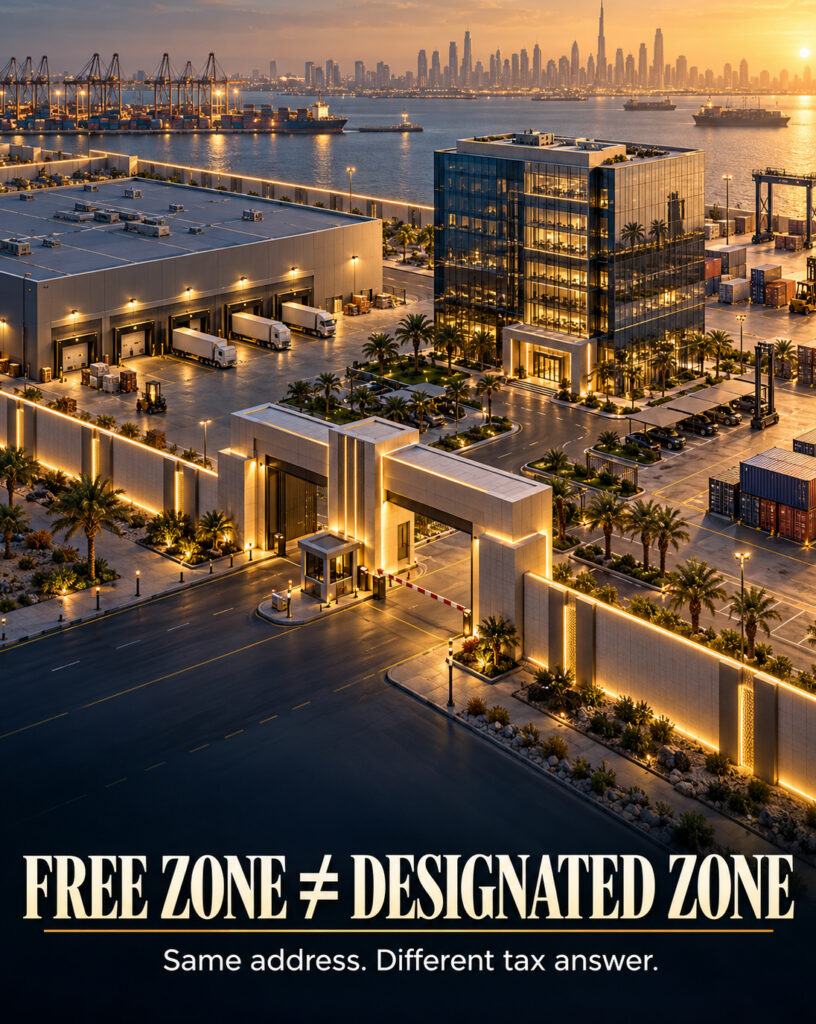
Many business owners consider a free zone and a designated zone to be the same. There are many differences between them. The meaning of each term is dependent on the tax law that is applied for each term. The UAE Federal Tax Authority (FTA) provides an explanation for this in Public Clarification TAXP010. The message it conveys is clear: assess your location independently under each tax law.

Why Designated Zone Status Differs by Tax
The definitions of both terms are brought together in one place in the clarification. It covers Corporate Tax, Excise Tax and VAT. It also reveals their differences. The clarification does not amend the law. It sets out the FTA’s stance and applies from the date when the relevant law came into effect.
Key Points the FTA Has Clarified
- VAT status does not automatically transfer to Corporate Tax. If a zone has been listed for VAT, it does not necessarily mean it is a designated zone for Corporate Tax. It also has to be a free zone as per the Corporate Tax Law.
- Distribution income requires a Corporate Tax designated zone. A Qualifying Freerider Zone Person (QFZP) receives a 0 per cent rate on distribution income. This only applies if goods are distributed in and from that zone and all conditions are fulfilled.
- The specific area also needs to be qualified. It must satisfy the conditions set out in Article 51(1), as confirmed by the free zone authority.
- Excise Tax follows its own test. It requires customs supervision as well as an FTA-registered Warehouse Keeper. Areas outside free zones can qualify if the Warehouse Keeper applies to the FTA.
Examples of Free Zone and Designated Zone Status
Jebel Ali Free Zone (JAFZA) is a free zone and a designated zone as well. It has been included in the FTA’s list since 1 January 2018. Supplies of goods inside the zone can be deemed to be outside the UAE for VAT. This holds if the specific area satisfies the Article 51(1) requirements. JAFZA is also included in the VAT list. So it can satisfy both tests for the Corporate Tax designation.
DMCC is a free zone, but it is not on the FTA list. It is deemed to be the mainland for VAT. A DMCC entity can still be a QFZP. But DMCC is not included in the VAT list, so it can’t be a Corporate Tax designated zone. A trader there cannot use the distribution activity for goods distributed from DMCC. It requires another qualifying activity or it must distribute from a zone with that status.
What Businesses Should Do Now
- Identify each legal entity, warehouse and plot to its status under Corporate Tax, VAT and Excise Tax. The licence address is not sufficient to base upon.
- Get written confirmation from the free zone authority or Warehouse Keeper. Check the current FTA list of zones.
- Trading and distribution companies should ensure that goods are imported through and distributed in or from a Corporate Tax designated zone prior to qualifying for the relevant tax treatment.
- Examine the VAT treatment of goods supplied in zones. Also review any Excise suspension positions based on location assumptions.
- Preserve the evidence on file. Recheck when premises are moved and when a new warehouse is added.
This is general information and not tax advice. Get specific advice for each business.
- Phone
- +971 56 524 0583
- [email protected]
- Office
- Office 217, Business Village, Block B, Al Maktoum, Deira, Dubai
- Hours
- Monday to Saturday, 9:00 to 18:00